

“Radical environmental groups” and “climate extremists” are “weaponizing” the courts against energy producers, Republican Senators Ted Cruz, Tom Cotton, Ted Budd and Mike Lee said in April. They designed the Stop Climate Shakedowns Act to effectively shield the companies that for decades have intensified the global climate breakdown (and lied about their responsibility) from litigation brought in either state or federal courts.
They fear that these lawsuits will “bankrupt our energy industry” – the same industry that spent nearly half a billion dollars throughout the last election cycle to lobby Donald Trump and Congress and that has reported extraordinary gains as the war in Iran sent oil prices soaring.
While the bill remains in the early stages, similar efforts by some states have already produced results. Fifteen laws seeking to block lawsuits against the fossil fuel industry from proceeding and prevent new ones from being filed have either been passed or are currently being debated in 11 Republican-led states, according to ProPublica. An investigation by ProPublica’s Abrahm Lustgarten linked these bills to groups with ties to conservative activist Leonard Leo, the man who orchestrated the right-wing takeover of the federal judiciary.
The US is not alone in this. In New Zealand, polluting companies may soon be shielded from civil lawsuits, as legislation proposed in May to retrospectively ban private citizens and organizations from suing businesses for their climate-damaging emissions appears poised to pass.
The push for such legislation coincides with an exponential growth in climate litigation cases. A recent Climate Litigation Network report describes climate litigation as a “global accountability system” used by private actors, civil society and individuals locally, regionally, nationally and internationally to hold governments and corporate polluters accountable. Over 3,600 climate change litigation cases have been filed in over 60 countries since 1986, with over three-quarters of them brought after the Paris Agreement was adopted in 2015.

“Polluter pays” litigation in particular is gaining serious ground. In polluter pays cases, claimants are required to prove a causal relationship between a defendant’s planet-warming emissions and a specific extreme weather event as they seek compensation for the damage polluters have caused to them and their communities.
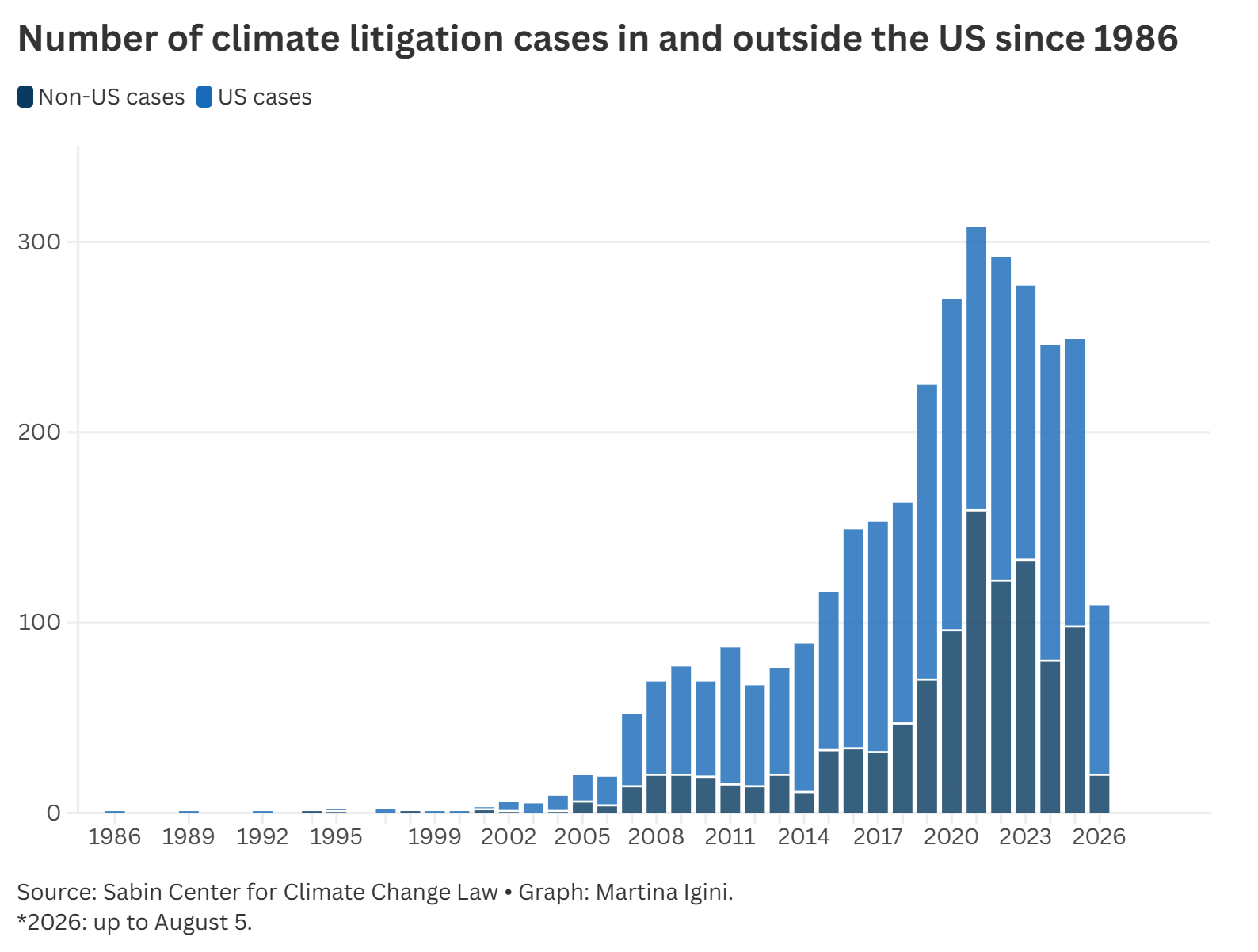
So, it comes as no surprise that the growth of such litigation has occurred alongside rapid advancements in attribution science – the climate field responsible for establishing this link.
To cite a recent example, researchers at World Weather Attribution, one of the leading groups carrying out rapid attribution studies, last week found that human-caused climate change made the extreme fire-prone weather fueling ongoing blazes at least twice as likely in France and 20 times more likely in Spain.
In a 2025 Science study, researchers used a well-established extreme event-based attribution framework to link the activities of the world’s largest fossil fuel and cement producers to hundreds of heatwaves worldwide this century. They found that 14 companies – including the usual suspects Saudi Aramco, Gazprom, ExxonMobil, Chevron, BP, and Shell – polluted enough to individually cause over 50 heatwaves.
That same year, another group of researchers created a framework that links the emissions of the world’s largest polluters to rising temperatures and specific heat-related climate disasters. “Causal linkages from emitters to impact have been termed the Holy Grail of climate litigation,” the Nature study states.
Attribution science has advanced rapidly in the past decade, with scientists now able to precisely estimate how much human-caused warming is shaping specific weather events in specific places. Despite some limitations and different methods producing different results, the field is now advanced enough to support lawsuits seeking damages for severe events worsened by global warming, according to a new report by the National Academies of Sciences, Engineering and Medicine (NASEM), the US’s top scientific advisory body.
The National Academies came under fire for the report, which lobbying group Energy in Depth, a project of the Independent Petroleum Association of America, called “the latest deliverable in a well-funded litigation campaign.”
In the months preceding its release, GOP-linked research group Argus Insight sought internal communications of the chair and other members of the panel tasked with writing the report while openly accusing them of having ties with climate advocacy organizations, documents obtained by Politico showed. It is a strategy Argus deployed before to collect information it deemed useful to discredit officials involved in climate lawsuits against fossil fuel companies. James Hurrell, the panel’s chair, has emphasized that “outside external chatter” did not influence their work “in any way.”
Shortly after the report’s release, the House Committee on Science, Space and Technology accused NASEM of withholding information the Committee had requested as part of its ongoing oversight of the institution’s federally supported activities. “Determining whether the congressionally chartered and federally funded NASEM is producing reports that are unbiased, nonpartisan, and free from conflicts of interest and, thus, whether legislative reforms are warranted with respect to the Academies as a whole, outweighs First Amendment interests of the individual members of a scientific committee,” the letter read.
In a post on Truth Social, Trump – a longtime fossil fuel ally – demanded an investigation into the independent organization, which he says is run by “Radical Left Dumocrats [sic].” Despite coming five days after the report’s release, his post did not address the new findings directly; instead, it targeted a reference manual that NASEM and the Federal Judicial Center created in 1994 to help judges manage complex technical evidence.
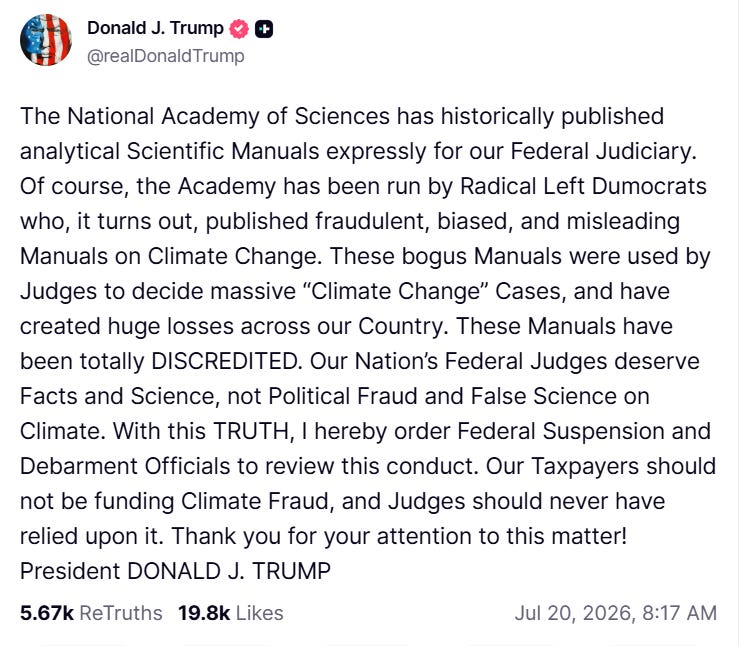
When the manual’s fourth edition was released late last year, the newly added chapter on climate science came under fire from 27 Republican state attorneys general, who claimed that its content was biased and threatened to undermine judicial impartiality. The Federal Judicial Center pulled the chapter in February in response, although it remains available on NASEM’s website. 28 co-authors of the manual called the removal a “political attack” and “a direct challenge to the independence of the federal judiciary,” noting that it could “hurt litigants on both sides of climate litigation.”
The AGs also took issue with what was included – and left out. They objected to the manual’s reliance on the Intergovernmental Panel on Climate Change (the world’s most authoritative climate body) and to its omission of a Department of Energy report (the scientific community has widely discredited the DOE report for its numerous “demonstrably incorrect” and “misleading” claims).
And in May, the Justice Department (DOJ) announced it had filed suits against Vermont, New York, Hawaii and Michigan, alleging that these states’ so-called “climate superfund” laws and planned legal actions against fossil fuel giants are in direct conflict with President Trump’s “energy dominance” agenda. “When states seek to regulate energy beyond their constitutional or statutory authority, they harm the country’s ability to produce energy and they aid our adversaries,” said Acting Assistant Attorney General Adam Gustafson of the DOJ’s Environment and Natural Resources Division.
The pattern across every front – from congressional bills and DOJ lawsuits to political attacks on scientific institutions – is clear. Opponents of climate accountability are not just fighting lawsuits in court; they are attempting to strip judges of the evidentiary tools required to hear them.
This coordinated, conservative-led offensive has one goal, according to former federal prosecutor and California state judge Alice Hill: “to keep attribution science out of court.” Big Oil is determined to avoid the fate of the tobacco industry, which was crippled by decades of intense litigation once internal deception and health harms were definitively linked.
While attribution science is far from a silver bullet for holding corporate polluters accountable, its rapid advancements are opening unprecedented legal doors for claimants. Whether state legislation can successfully insulate the industry from that liability remains to be seen.